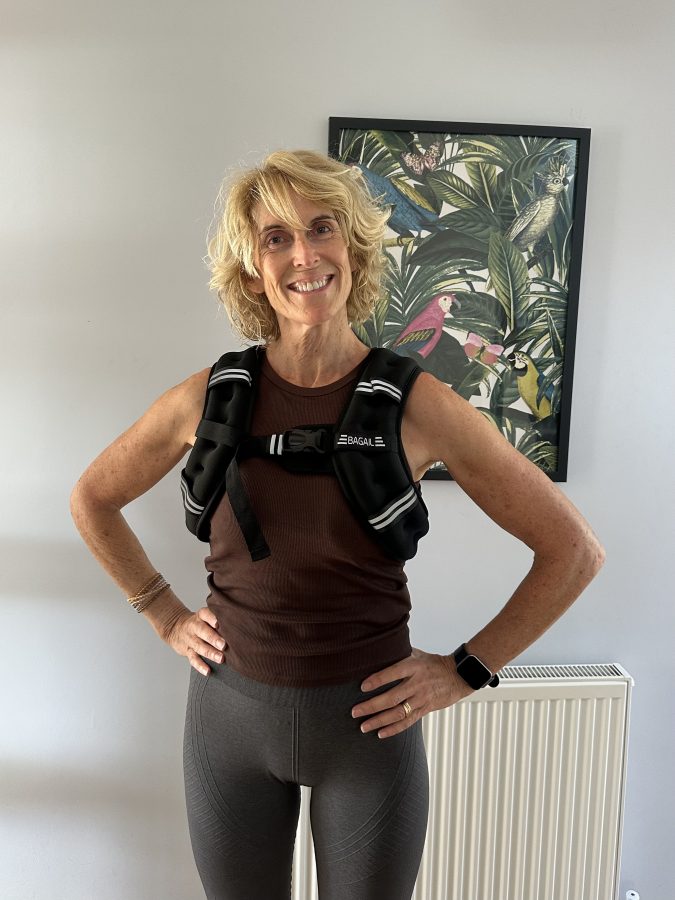
After breaking my arm 4 years ago & discovering I had osteopenia (low bone density) via a Dexa scan, I was determined to strengthen my bones.
I bought a weighted vest & thought I’d share what I’ve found, why you might want one & what the latest research says about weighted vests & bone health.
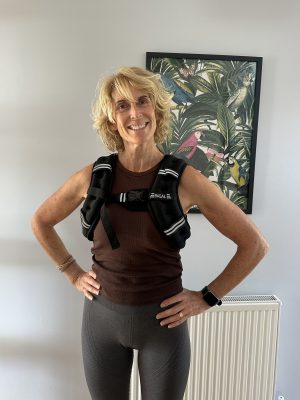
That’s me in the photo above. I wear my vest around the house – when I remember! – & out on brisk walks. Whilst I’ve not used it for this yet, I could also wear it during simple strength-building exercises like step-ups, squats & lunges.
But first ….
our bones are listening. they need loading
Growing research suggests additional load may be useful for bone health.
As you probably know, after 30 we begin to lose bone density – ie. they start to loose their strength & become porous.
But! our bones are living tissue. They are continually remodeling in response to the demands placed upon them – regardless of our age.
When additional weight is placed on our skeleton, the bones respond by adapting their structure to become stronger over time.
This is one reason why weight-bearing & resistance exercise are recommended for bone health during & after menopause.
Here’s the interesting bit…
You don’t have to lift heavy weights, jump or run to increase the load on your skeleton.
A weighted vest can help.
How does a weighted vest help our bones?
Imagine walking without a vest.
Your skeleton is supporting your body weight with every step.
Now imagine adding a small amount of weight with a weighted vest.
Your muscles have to work a little harder and your skeleton experiences additional loading.
Your body now has a new, manageable load bearing stimulus.
What does the research say about weighted vests & bone health?
There is encouraging evidence around weighted vests.
If you’d like to know which research studies have been used for this blog post, I’ve included them below.
New 2026 research
A 2026 review analysed nine previous vest trials that had involved 368 middle-aged and older adults.
The research found that weighted-vest exercise was associated with significantly better bone mineral density compared with usual activity without the vest.
The research found that weighted-vest exercise was associated with significantly better bone mineral density compared with usual activity.
Improvements were particularly seen in the :
- Femoral neck (top of thigh bone) & lumbar spine. The femoral neck being an important area to measure as hip fractures can have serious consequences as we age.
So the message from this 2026 review is :
“Weighted-vest exercise is a promising way of increasing mechanical loading and may be a useful addition to a bone-strengthening exercise programme.”
How heavy should a weighted vest be?
Research studies have used different loads – from 4–8% of body weight in some studies to considerably higher loads in progressive exercise programmes where people already had base line fitness. (PubMed)
I bought a 10llb vest from Amazon – because I’m bit of an ‘all or nothing’ person! But, if you’re starting out I would recommend :
- Start lighter than you think you need – the vest should fit snugly without restricting your breathing or movement. Choose one with removable weights – some have removable sand bags or iron plates that you can add to the vest as your strength and tolerance improves.
- It shouldn’t bounce around or pull you backwards when moving around in it. Choose one with two straps that clip across the front of the body &, even better, one with padding on the shoulder straps.
More weight isn’t necessarily better
This is really important.
When it comes to bone health, the goal isn’t simply to put on the heaviest vest you can tolerate.
Bones respond to mechanical loading, but exercise needs to be appropriate for the individual.
Current guidance recommends varying the rate of loading rather than repeatedly exposing your bones to exactly the same stimulus. (PubMed Central (PMC))
For someone who is already strong and accustomed to resistance exercise, a weighted vest might be a useful way of progressing their training.
Please Note: For someone who is deconditioned, has osteoporosis, has experienced a fracture, has significant joint problems or has spinal issues, the appropriate type and amount of loading may be very different.
So, should you try a weighted vest?
For a healthy, active woman over 50 who is already comfortable with weight-bearing exercise, a weighted vest could be an interesting way to progressively increase the loading challenge.
It may be particularly useful when an activity has started to feel very easy.
But think of it as one tool in your bone-health toolkit, rather than a shortcut to stronger bones.
Your toolkit might include:
Strength training + weight-bearing exercise + balance work + appropriate impact + good nutrition + enough protein, calcium and vitamin D + recovery.
One important reality check
If you have osteoporosis, a history of fractures, significant joint problems or other health concerns, please seek advice from your GP, physiotherapist or qualified exercise professional before introducing weighted exercise or impact work.
For bone health, a combination of weight-bearing activity and resistance exercise is generally a better approach than relying on one form of exercise alone. This is also consistent with current UK osteoporosis guidance. (PubMed Central (PMC))
Our bones respond to several factors – loading, strength building exercise, nutrition, hormones, age and other factors.
Here’s The Research
- Yue et al. (2026) – Effects of weighted vest on bone health and body fat in middle-aged and older adults: a systematic review and meta-analysis. Nine randomised controlled trials, 368 participants. (PubMed)
- Klentrou et al. (2007) – Effects of exercise training with weighted vests on bone turnover and isokinetic strength in postmenopausal women. Journal of Aging and Physical Activity. (PubMed)
- Shaw & Snow (2000) – Long-term exercise using weighted vests prevents hip bone loss in postmenopausal women. (PubMed)
- Bocalini et al. / related weighted-vest walking research – postmenopausal women with osteoporosis undertaking treadmill exercise with 4–8% body-weight loading. (PubMed)
- 2024 UK Clinical Guideline for the Prevention and Treatment of Osteoporosis – current UK guidance on weight-bearing and resistance exercise for bone health. (PubMed Central (PMC))
You might also like to read my posts:
Why Strength Training Matters for Women over 50 – & How Yoga Can help.